Environment and Science
The Arava Goats Sparking Interest in Europe
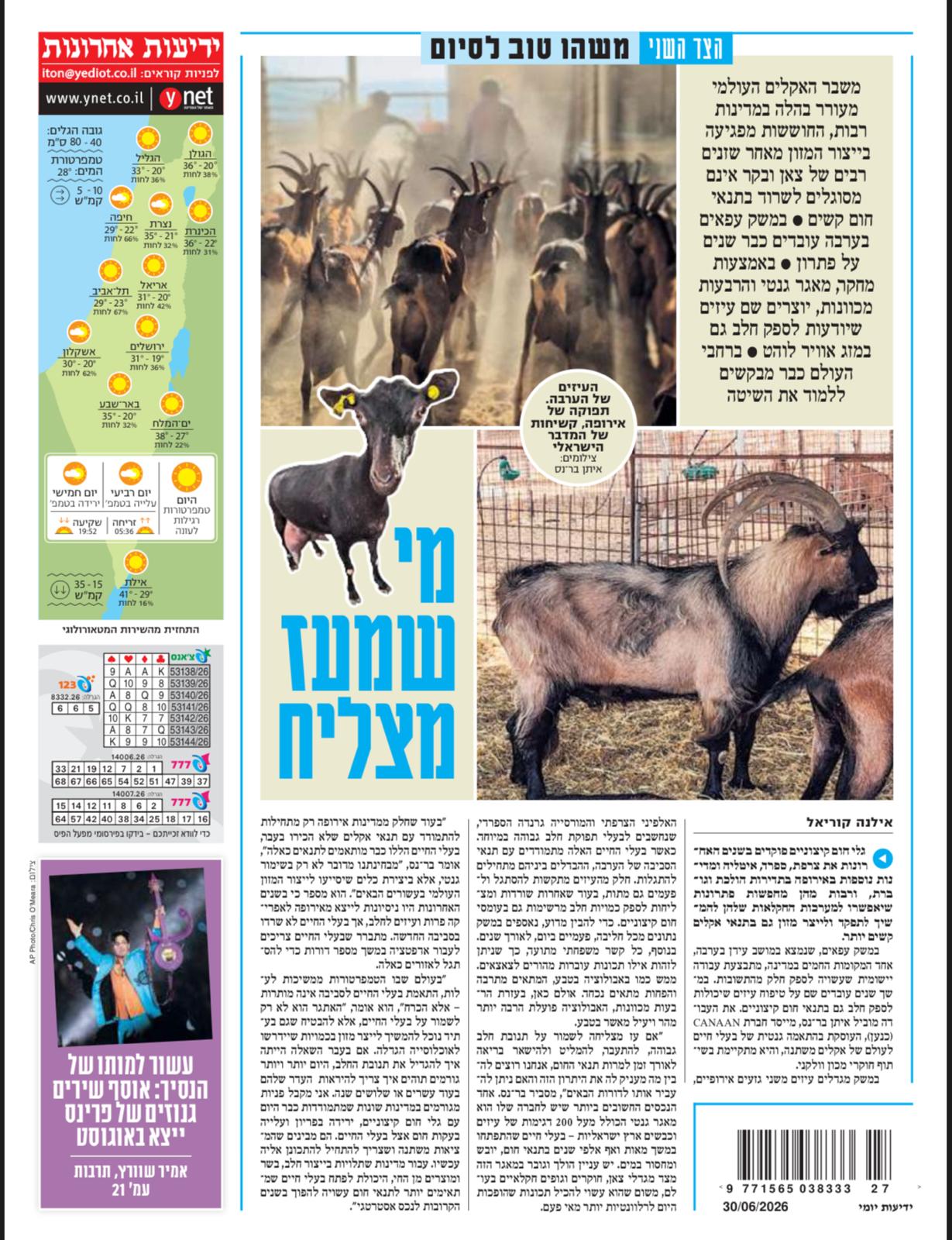
The global climate crisis is causing panic in many countries that fear disruptions to food production, as many breeds of sheep and cattle cannot survive harsh heat conditions. At the Ofaimme Farm in the Arava, they have been working on a solution for years. Through research, a genetic database, and targeted breeding, they are developing goats capable of producing milk even in scorching weather. Around the world, people are already asking to learn their method.
By Ilana Curiel
Tags: Arava, Animals, Climate Crisis
Extreme heatwaves have hit France, Spain, Italy, and other European nations with increasing frequency in recent years. Many of these countries are looking for solutions that will allow their agricultural systems to keep functioning and producing food under harsher climate conditions.
At the Ofaimme Farm – located in Moshav Idan in the Arava, one of the hottest places in Israel-practical work is underway that could provide some of the answers. For years, they have been working on breeding goats that can provide milk even under extreme heat conditions. The project is led by Eitan Bar-Ness, founder of CANAAN, a company specializing in the genetic adaptation of livestock to a changing climate, and it is being conducted in collaboration with researchers from the Volcani Institute.
The farm raises two European goat breeds, the French Alpine and the Spanish Murciano-Granadina, both considered exceptionally high milk yielders. However, when these animals face the environmental conditions of the Arava, the differences between them begin to emerge. Some of the goats struggle to adapt and sometimes even die, while others survive and manage to yield impressive amounts of milk even during extreme heat stress.
To understand why, data is collected at the farm from every single milking, twice a day, over a span of years. Additionally, every family lineage is documented to identify which traits pass from parents to offspring. Just like evolution in nature, the fittest reproduce and the less fit die out. Here, however, with the help of targeted breeding, evolution moves much faster and more efficiently than it does in the wild.
“If a goat manages to maintain high milk yields, get pregnant, give birth, and stay healthy over time despite the heat, we want to understand what gives her that advantage and whether it can be passed on to future generations,” Bar-Ness explains. One of his company’s most valuable assets is a genetic database containing over 200 samples of indigenous Israeli goats and sheep-animals that developed over hundreds or even thousands of years under conditions of heat, aridity, and water scarcity. There is growing interest in this database from livestock farmers, researchers, and agricultural organizations worldwide because it likely contains traits that are becoming more relevant today than ever before.
“While some European countries are only just beginning to face climate conditions they’ve never experienced, these animals are already adapted to them,” says Bar-Ness. “For us, this is not just about genetic preservation; it’s about creating tools that will assist global food production in the coming decades.” He notes that in recent years, there were attempts to export dairy cows and goats from Europe to Africa, but the animals did not survive the new environment. It turns out that animals need to undergo adaptation over several generations to adjust to such regions.
“In a world where temperatures continue to rise, adapting livestock to the environment isn’t a luxury-it’s a necessity,” he says. “The challenge is not just keeping the animals alive, but ensuring we can continue to produce food in the quantities required for a growing population. If the question in the past was how to increase milk yields, today more and more entities are wondering what their herds should look like 20 or 30 years from now. I receive inquiries from organizations in various countries that are already dealing with extreme heatwaves, drops in fertility, and rising heat stress in animals. They understand that reality is changing and that they need to start preparing for it now. For countries reliant on the production of milk, meat, and animal products, the ability to develop livestock better suited to heat conditions could become a strategic asset in the coming years.”
https://www.ynet.co.il